Tuesday, January 09, 2007

Smoking: Ruby and Glen Say No to an Incredibly Powerful Addiction

My sister Ruby and her son Glen, both heavy smokers, have decided to quit. This is big news in our family and happy news.

They know that if they don't, this graphic picture of smoker's lungs could easily be a preview of their future. They are determined that it will not be.

There is no longer any doubt about the direct link between smoking and lung cancer, a horrific disease whose symptoms often do not show up until it is too late.

Lung cancer is the leading cause of cancer mortality in the United States. In 2007, it is expected to kill some 160,000 people with most of the deaths directly linked to smoking. It is not the nicotine that causes the cancer but residue carcinogens -- such as tar -- that accumulate in the lungs. Thus the picture above.

Ruby and Glen both know all this and have known it for a long time while continuing to smoke. Why? Make no mistake, smoking is an addiction that can obliterate reason and even the instinct for self-preservation. It's grip is so powerful that it is not unusual for people with blackened lungs and hooked up to oxygen to continue lighting up.

So what Ruby and Glen have decided to do -- break a powerful addiction-- is tremendously difficult. Many people try to stop smoking and repeatedly fail. But knowing these two, knowing their strong wills, knowing how much they have to live for, ... well, my money is on them pulling this off.

Ruby and I are two of five siblings and I am the only one who has never smoked. I'm not pumping myself up here. My lifelong non-smoking came about only because of a lucky childhood incident. I and a few friends stole some money from a drunk (we saw him hide money in an alley) and, through an enabling adult, spent it all on cigarettes.

I had never smoked a cigarette before but it seemed such a cool, grown-up thing to do. Humphrey Bogart always had a butt hanging from his mouth. Want to be grown-up, popular with the girls, Bogart-tough, smart in the ways of the world? In those days, in the early 1950's, you smoked.

We took our packs of cigarettes and went to the movies. In the dark, we lit up cigarette after cigarette and smoked every one. Smoking was allowed in the movies then. It was allowed everywhere, in fact. America loved cigarettes.

For my youthful reach for Bogartdom, I got the mother of all headaches. I thought my head was going to split open. My throat burned. My stomach felt like it was going to explode. I ran out of the theatre and puked in the street. And puked. And puked. Even when there was nothing more to come out, I rolled in the street in agony with the dry heaves.


I never smoked another cigarette. The best I could do was to fake being a smoker, as in this photo with my sister Ruby. I was also faking drinking, having gotten so sick at my first drinking experience in high school that I stopped drinking the same time I started. To this day, I never take a drink.


Unlike me, all four of my siblings took up smoking. My sister Marion, an RN and a longtime nursing executive at a large Massachusetts hospital, smoked for more than 20 years before she managed to quit more than ten years ago.

Same with my brother Victor, who quit three years ago when he met Marianne. She is a nurse with a dim view of smoking. With her in his life, he basically had to choose between her and smoking. He chose her and we're all glad he did.

My brother Reggie, the baby, is still a smoker. Like every smoker, he knows he shouldn't and he knows exactly why. The photo above of a smoker's lungs would not be news to him. He's a smart guy who reads and knows the score.

He doesn't need me or anybody else to tell him to give up smoking or even to bring up the subject. If I said anything to him, he'd tell me to mind my own business. That would be the best response I could hope for.

So I have not said anything to him and do not intend to do so. The silence does not mean that I don't care about my baby brother. I do. But he has a right to smoke and I have to respect that. And only he can decide when the time comes, if ever, to quit.


However, if I thought I could get Reggie to quit, I would speak up in a second. I would gladly take a punch in the mouth if that was the price of getting him to quit. Ah ... hold on. A punch in the mouth? Smashed lips? Spitting out teeth? Facial reconstruction? Don't get me wrong. I love Reggie, but could I sort of think on this a bit?

Just as I never said a word to Marion or Victor or Reggie, I have also been silent in the face of my sister Ruby's heavy smoking. I sat with her in her smoking room-- I called it her "workout room"-- while she puffed away. At family gatherings, I went outside with her when she went for a cigarette. Always I was silent. And always I was sick inside with the thought of losing her.

Ruby has been smoking for a half a century. One time Marion said something to her about her smoking and was told in no uncertain terms to mind her own business. And so Ruby, who has a master's degree in social work and is a licensed social worker, went on smoking, year after year. The same was true with her son -- and my nephew -- Glen.

They became smoking buddies. At family gatherings, they disappear outside together for a cigarette. I often join them. I love Glen. We have a lot of fun together, laughing and joking. He's quick to laugh. My comic routines often bomb, but they never do with Glen.

He's young, hard-working -- operating his own machine shop--, ambitious, has a great wife and two beautiful young children. Yet often when we're together and I'd be making him laugh and he'd be ribbing me about something, he'd take out a cigarette and take a long, deep drag.

I would do my best to ignore the cigarette and even step up the tempo of the banter to overwhelm any sign of judgmentalism on my part. Yet I could not turn off my brain which told me that I was in the presence of slow suicide by someone I loved. I feel about Glen the way I feel about his mother: I don't want to lose him.

All of this changed a couple of weeks ago when my niece Linda, Glen's sister, told me that she had some good news for me. Now she and I are also very close and we often talk about how worried we are about her mother's and Glen's smoking. We feel completely helpless. If we say something, we know we'd get our heads handed to us.

"Mom and Glen are going to quit," Linda said.

"What?" I asked, disbelievingly.

"January 2. They're going to do it."

"They're serious?"

"Yes, dead serious."

"Oh my God! This is fabulous! This is the best news I've heard in years."

"Isn't it great? I'm so happy."

"Does this mean we can talk about it?"

"Yes. In fact, they need support, especially mine and yours."

I immediately called them both. "Is it true?" I asked them. Both said it was true and that they were determined to quit.

Glen said he was already taking a prescription medicine, Chantix, that is supposed to curb the cravings. But he said it was expensive, $232 for a month's supply, and he was going to take the pills for three months. His insurance company refused to cover it.


He complained to the company. "What do you mean you don't cover it," he said. "This is preventative. I'm saving you a lot of money down the road." After he made several phone calls and filled out two sets of forms, the insurance company finally agreed to cover the cost of the medicine.

Chantix, a six-month-old drug from Pfizer and the first new quit-smoking treatment in a decade, is helping. The drug works by partially stimulating certain nicotine receptors in the brain. It mimics the pleasurable effects of the addictive agent while blocking nicotine from binding to the receptors, delivering a buzz to the would-be quitter but a less than satisfying one.

Ruby had decided to go with the patch, which seeks to ease smokers out of the addiction by delivering small, steady doses of nicotine. She was already wearing the patch when I saw her a few days later. I hugged her and told her how happy I was that she was going to quit.

"This means that I can talk about it?" I asked warily.

"Yes."

"What a relief," I said. But I still wasn't sure. When the going gets rough, I was afraid she still might bite my head off. But I told Ruby and Glen that they had my 100% support.

I told them both that if they needed help, to call me any time day or night and I'll be there. "We'll do what it takes," I said.

However, Marion is the key supporter. Not only has she stopped smoking herself but she also teaches smoking cessation. She knows more about the process than any of us. After years of rebuffing her help, even telling her firmly to mind her own business, Ruby has finally accepted Marion's help.

In the days before January 2, both Ruby and Glen went on smoking binges. They smoked one cigarette after another, inhaling deeply and pleasurably. Deep-breathing itself is relaxing. But the main reason smoking is so pleasurable is that nicotine is a fast-acting drug; it goes straight to a part of the brain.

When receptacles there receive the nicotine, they signal another part of the brain to release a chemical, dopamine, that gives the smoker an almost immediate high. When you are used to this high, look forward to it, and in fact are dependent on it, it's hell to give up -- as countless people who have tried and failed to do so will tell you.

As if this physical addiction were not enough, smoking also insinuates itself into both pleasurable moments-- a work break, after a meal-- and times of stress. In crisis, many smokers reflexively fumble for a cigarette. During 9/11, ABC newsman Peter Jennings said that "he was weak" and began smoking again after having given it up several years before. He died of lung cancer caused by smoking.

On January 2, Ruby and Glen began what they were determined would be new non-smoking lives. As this is being written, it has now been a full week and neither one has had a cigarette. At work, Ruby even went outside with a colleague that she regularly smoked with and did not have a cigarette. The past weekend she distracted herself by working nonstop on her income taxes.

Ruby and Glen are talking every day and Linda is talking to them both. I have stopped by and called. This Friday night Ruby will be coming over for dinner and my wife Barbara and I plan to keep her entertained and occupied.

Marion says that the more open a smoker trying to quit is and the more people she tells, the better. "Telling people is affirmative," Marion said. She says it is a way to gather strength from others and increases the chance of success.

Marion is calling Ruby every day. Besides showing her love and support, Marion is passing on what she has learned from successfully quitting herself and as a teacher of smoking cessation. When Ruby feels that she has to have a cigarette, Marion suggests that she give herself a half hour to reconsider. The delay offers a chance to take a different direction, Marion says.


The photo shows Ruby and her son Glen having one of their last smokes together, in the garage of Linda's house. I went out there with them to share the moment and to capture the momentous occasion for the family history book.

Glen is more worried about his mom than himself. He's sure he is going to make it, though he's eating tons of food and chewing gum nonstop. But he points out that his mom has been smoking all her adult life and her habit is deep and pervasive. She's been eating bags of popcorn, he said.

I showed Glen this post and he embraced it as real and human. It even made him laugh in places. But he suggested that because his mom was "still on edge," we not show it to her until a little more time passes. "Later, when she knows that she is going to make it, I think she will really appreciate it," Glen said. "But not now."


According to an article by George Stephos based on research by the drug giant Pfizer, one of the main reasons it’s so hard to quit smoking is because all the benefits of quitting and all the dangers of continuing seem very far away. Here, from studies by Pfizer researchers, are some of the immediate, physical benefits of quitting smoking that Ruby and Glen have already received and others they will gain as time goes by:

In 20 minutes after the last cigarette, blood pressure drops back.


In 8 hours, the carbon monoxide (a toxic gas) levels in the blood stream drops drop by half, and oxygen levels return to normal.


In 48 hours, chances of having a heart attack have decreased. All nicotine will have left the body. Sense of taste and smell return to a normal level.


In 72 hours, bronchial tubes relax and energy levels increase.


Ruby and Glen have already gained the above benefits.

In 2 weeks, circulation improves and it will continue to do so for the next 10 weeks.

In three to nine months, coughs, wheezing and breathing problems will dissipate as lung capacity improves by 10%.


In one year, risk of having a heart attack drops by half.


In 5 years, risk of having a stroke returns to that of a non-smoker.


In 10 years, risk of lung cancer returns to that of a non-smoker.


In 15 years, risk of heart attack returns to that of a non-smoker.

So, Ruby and Glen, when you find yourself freaking out for a cigarette, do what Marion says and give yourself a 30-minute delay. If you give yourself a chance to say no to a cigarette, you will. It worked for Marion. Victor stopped smoking. Both of you will, too. Hey, you've already been cigarette-free for a week!

You're going to do it! You are doing it!

With love and my 100% support,

George

P.S. Free stop-smoking services of the Massachusetts Department of Public Healthcare are available online at: trytostop.org/ and quitworks.org/. Services include free counseling at 1-800-879-8678 and lots of free information. Finally, only 5% of smokers who try to quit on their own succeed. This poem understands why. It looks like Ruby and Glen are going to be in this elite 5%. Hip, hip, hooray!


So long and keep moving.

Update: Ruby and Glen both went back to smoking. Glen stopped in 2009, went nearly three years without a cigarette, then began smoking again in early 2012.  He's smoking furiously today. Ruby also went back smoking. But after a trip to the emergency room in 2011 for trouble breathing, she stopped smoking -- and remains smoke-free today.  She doesn't say a word to Glen about his smoking. "I know it won't help," she said. "He'll just get mad at me. That's how I was. If you said something to me, I would have told you to mind your own business." I'm glad I kept my mouth shut.

                                                  E-Books by George Pollock

 "State Kid: Hero of Literacy" is fiction based on his  real-life experiences  growing up in foster homes; "Last Laughs," is the true story of how five foster kids (he and four younger siblings) found their way in life and each other. "Killers: Surprises in a Maximum Security Prison," is the story of his being locked up for 23 hours with killers in a maximum security prison;  "I, Cadaver" is about his postmortem adventures and mischief in the anatomy lab at UMass Medical School. “A Beautiful Story” demonstrates the art and process of creative writing as a 16-year-old boy goes all out to write a story that literally saves his life;  "A Long, Happy, Healthy Life," which is about how to live the title every day; and "Unlove Story," Writing anonymously as "Elvis," a husband, dumped after 38 years of marriage, lets it all out on love, marriage, life, everything. A guy doing this? It's unheard of.

Labels: , , , , , , , , , ,

Tuesday, February 07, 2006

Human Mortality: Peter Jennings, Bob Woodruff, Elizabeth Vargas, You, and Me


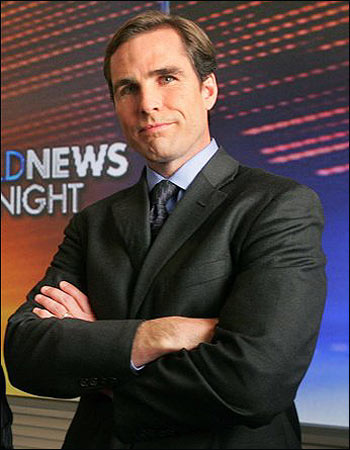
Ah, death, so feared, so upsetting of our best-laid plans, so repulsive and magnetic at the same time, so everywhere. Elizabeth Vargas and Bob Woodruff, above, of ABC World News Tonight are living in its giant shadow.

Major TV news networks give us nightly images of U.S. military vehicles pulverized by roadside bombs in Iraq and victims being carried away on covered stretchers. Almost by habit, and using language identical to that used many times before, television reporters tell us how many died in the attack and how many were wounded.

Try as they may, however, TV reporters cannot easily distinguish one attack from the other nor convey fully that these are human beings being killed and maimed. It becomes, forgive me, almost routine – until it happens to somebody with a face we know.

At ABC's World News Tonight, inconceivably, it happened to a colleague, Bob Woodruff. Then the full horror of a roadside bomb hits home. Just six months after losing Peter Jennings, it's anchor for more than two decades, to lung cancer, ABC World News Tonight has had his co-successor seriously wounded in action on the front lines of news.

It happened on a Sunday and the news immediately led on ABC. On Monday, the lead story in The New York Times -- that is, the front-page right column, considered the world's most important of the day -- was about Bob Woodruff and the attack. Along with a cameraman, Doug Vogt, a Canadian living in France, he was embedded with the U.S. Army's 4th Infantry Division.

The two were riding in an Iraqi, Soviet-made, lightly armored personnel carrier. It was the lead vehicle in a joint American-Iraqi convoy. Wanting to see everything and to have an unobstructed view for filming, the two men stood partially exposed in an open rear hatch. They wore body armor, ballistic glasses, and helmets.

It wasn't enough. The powerful blast sent shrapnel tearing into each man's head and upper body. The blast was followed by small arms fire from several directions. Bob asked, "Am I alive?" and then screamed in pain. Wounded and bleeding, Bob and Doug were taken by helicopter to the fortified Green Zone.

There both underwent lengthy emergency surgery. With shrapnel in his head and neck and with broken bones, Bob was in more serious condition than Doug.

I was away for a long weekend without access to TV or a computer, so I learned about the news in Monday's Times. I was shocked.

This was not a "normal" roadside bombing in Iraq. It had a victim whose face I knew. I devoured every word, discussed it at length with my wife, and went online to find out everything I could.

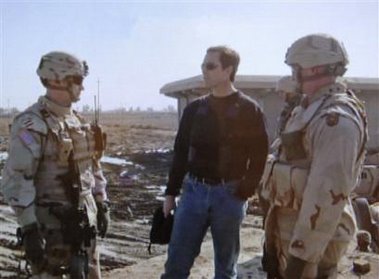
Bob is shown here about thirty minutes before the attack. On the road, Bob and Doug switched from a heavily-armored American Humvee to the lightly-armored Iraqi vehicle, which left them more exposed.

As I write this, two weeks after the attack, Doug Vogt is up walking and talking, but Bob Woodruff lies in a medically-induced coma at the National Naval Medical Center in Bethesda, Maryland while doctors treat serious shrapnel wounds to his head and neck.

To relieve pressure on Bob's brain from swelling, surgeons removed part of his skull. He is expected to survive. However, no one can say when or if he will be able to return to his co-anchor spot alongside Elizabeth Vargas.

Doctors are careful not to say it, but Bob could have suffered brain damage with a possibility of impaired cognition and speech -- which could make his return impossible. Aware of the seriousness of her co-anchor's condition, Ms. Vargas has struggled to keep her composure while reporting on her colleagues' medical progress.

But her emotions finally got to her. At the end of a broadcast the other night, she turned away from the camera sobbing. As a viewer, I feel the same way. I'm still in mourning for Peter Jennings. For me, it is personal with Bob Woodruff as it was and is for Peter Jennings (even after nearly six months).

I can only imagine how Elizabeth Vargas feels. For months while Peter Jennings lay dying, she had to sign off the broadcast saying "for Peter Jennings," and now she has to do a "for Bob Woodruff. And ABC World News Tonight, reeling from having two news stars yanked by fate from its anchor's chair within a year, has much to ponder about life and human mortality.

The ordeal of ABC World News Tonight is a terrible reminder that disease and death stalk us all, and that celebrities like Peter Jennings and Bob Woodruff are also mortal. For 22 years, I watched Peter Jennings on ABC News every night and literally for hour upon hour during every major news event. I was with him at the fall of the Berlin Wall, the first Iraq war, every presidential convention and election, 9/11, the second Iraq war, and every celebrity death.

And like the good newsman that he was, he soared above it all. With every celebrity death that Peter Jennings announced on TV was an implict understanding that this could never happen to him. All those images of him, pictured here, over so many years had made him immortal in my eyes and in the eyes of many millions worldwide. This was so comforting, so permanent.

When he did not cover the funeral of Pope Paul VI, when in fact he was nowhere to be seen at such a major world news event, I immediately felt that something was terribly wrong. Then one night in April, 2005, at the end of the news, in a hoarse voice punctuated by little coughs, he gave us the news himself. Lung cancer.

Shocked to the core, I hung on his every word. He said he had been weak after 9/11 and had taken up smoking again after quitting many years before. He said that he now joined 10 million other cancer survivors and that he would have good days and bad days and that his voice wouldn't be this bad on his good days.

He said he would be starting chemotherapy. Forcing a smile, he wondered if he should ask the doctor when his hair would fall out. He spoke as if this bit of news wasn't, in the overall scope of things, anything out of the ordinary and that he would just carry on as always; he'd just do so as a lung cancer survivor, that's all.

But for once, Peter Jennings could not be above it all. The lung cancer was not some other celebrity's; it was his. Lung cancer is one of the most deadly cancers. The choice of chemotherapy over immediate surgery was the tip-off that he had advanced, inoperable lung cancer. I for one saw a dead man talking on TV that night and I suspect his doctors did as well.

Peter Jennings never returned to the air. After that last appearance, he continued coming into the ABC office, diving into the news as he always did. And then he went into seclusion. A man who had spent his life digging out news became the object of a news blackout. Week after week, I heard not a word. It hurt.

It was as if a member of the family had disappeared into thin air. The urbane air, the soothing voice, the ever so underplayed bemused look was as much a part of our living room as family photos and keepsakes. I wrote an e-mail to a website devoted to discussing Peter Jennings in which I begged him to tell us how he was doing.

Nothing, except for a few messages from him posted on the ABC web site thanking people for their support and prayers. But on his illness, treatment, and feelings there was only silence. The next thing I heard was the formal announcement of his death, saying that he had died with his wife and family at his bedside.

A public figure had chosen a private death. Of course, that was his right and must be respected. But I can't help wondering what Peter Jennings thought about his own impending death and what he would say to the rest of us as we all face our own. What could he have taught us?

We'll never know.

Even if Peter Jennings had spoken to us, we still would be left to deal with death as individuals. The truth is, we deal with it miserably and the three biggest failings are: Individually and collectively, we refuse to take steps to keep healthy and prolong our lives; have a propensity to die unexpectedly and in unforeseen ways; and when death does come, we can't cope with it.

In all three areas, Peter Jennings, sadly, followed the script to a T. He smoked, stopped, but knowing better ( having hosted a special ABC special on smoking), he took up smoking again. If ever there was an unexpected death, it was that of TV-immortalized Peter Jennings. For him to die of lung cancer was not only unforeseen but unimaginable.

However, there is some small consolation for Peter's family and his millions of viewers: his memory will live on. The block in Manhattan where ABC News is located and where he lived and used to walk to work has been renamed Peter Jennings Way. Though a man of the world, this was his neighborhood. This was the center of his life. And now it has his name.

In private, Peter Jenning's death may have been like his life: triumphant. I hope it was. In public, however, he coped with death by denying it.

In this respect, Peter Jenning acted just like the rest of us. We don't think about death until it literally strangles us or runs us down in the street or, as with Bob Woodruff, puts a bomb in our path.

I have a modest suggestion: Maybe the time to prepare for death is when we are healthy, happy, and enjoying all that life has to offer. That describes my life today and yet here I am writing about dying -- and I will get to my own death at the end of this post.

What can we learn from the death of Peter Jennings and the cruel twist of fate that has befallen Bob Woodruff'? In other words, what do we intend to do about our coming death?

The choices are many, ranging from do-nothing fatalism to busily making plans to live forever.

Ray Kurzweil, shown here, is a 57 year-old inventor who plans to live forever. Author of "Fantastic Voyage: Live Long Enough to Live Forever," he says that by continuously "fixing everything that goes wrong," it is possible to live indefinitely.

What makes it possible, he says, is the great increase in life expectancy coupled with ever faster and ever revolutionary progress in medicine and technology.

He points out that life expectancy in 1800 was 37. Today in the U.S. it is approaching 80 and will surpass that in a few years, he says. He predicts that in 20 years diseases like Alzheimer's will be rendered harmless by introducing nanobots in the brain to untangle tangles and dislodge amyloid deposits. His goal is to live long enough to take advantage of this new medical technology.

Being a scientist, Kurzweil is methodical in keeping himself in excellent health. He keeps track of everything he eats, counts calories, takes several supplements, exercises, and tests himself regularly. He has brought his cholesterol down from 280 to 130.

At age 57, he says tests put his biological age at 41. He says that in the last 17 years he has aged just two years biologically. At age 60, he expects to have a biological age of 38.

Other people, conceding that they are likely to die, are hoping to rise from the dead. They are making arrangements with cryogenics centers to have their bodies frozen until science figures out a way to bring them back to life.

Some of them are drawing up legal papers leaving their wealth not to the kids but to themselves, so when they do come back from the dead they'll have the means to enjoy life forever.

Normally death comes unannounced. Even if it is expected, it still tends to come as a surprise. Some of us get unequivical advance notice. Peter Jennings was one. He had to know that his lung cancer was going to kill him and not take very long to do it.

How he made use of this time, I don't know. Well, I like to think. It is possible to live more fully in a short time at the end of life than in an entire life.

Eugene O'Kelly was 53 and chief executive of the big accounting firm KPMG when he was told that he had inoperable brain cancer. A wealthy, successful, hard-driving businessman, he was determined to turn his death into one last success. He would talk directly to healthy people and tell them to heed Jonathan Swift: "May you live every day of your life."

Given just a few months to live, he drew up "to-do" lists just as he always did when he had to pull off something big. A successful death was certainly something big. High on his "to-do" list was saying goodbye in person and privately to about a thousand people. In doing so, he sometimes asked a friend or acquaintance to take a leisurely walk together. For all, it was a last such walk; but for many, it was also the first.

He wrote a book, "Chasing Daylight: How My Forthcoming Death Transformed My Life." In it, he expressed his delight in discovering the world around him and new sensations of connecting to nature and living for the moment instead of drawing up five and ten-year plans.

In simple and clear language, he voiced universal truths. The book is successful and so was, on September 10, his death.

Mr. O'Kelly found great comfort and inspiration in his religious faith. Many other people of faith don't try to manage death the way he did. They take death as a given that will come in God's good time. For them, following His word in life is not only the best preparation for death but the only way. Death may be sorrowful and marked by sombre church ritual, but it is also celebrated as a passage to the hereafter, a joyful reuniting with God, and eternal happiness.

Me, I'm with Sherwin Nuland (see previous post). I'd like to stay out of the way of his Six Horsemen of Death to say age 120 and then go to sleep. But don't get me wrong. If it doesn't happen, and it probably won't, I'm okay with it. I'm a couple of years away from 70 and that's already a lot older than many people get to be. Probably half the people in the daily obituaries are younger than I am.

If I drop dead after I post this, people would say, "Oh, George died. But you know, he had a long good life. He played tennis to the last day of his life. He was lucky."

They would be right. Getting to this age has been a fabulous ride and a great privilege. I'm ready to go. And thank God, not being a celebrity, I won't have to die like Peter Jennings or fight for life like Bob Woodruff, with the whole world watching.

But don't misunderstand. I didn't say I want to go. I hope to stay vertical and viable for another 50 years. I say this fully aware that living that long can truly be a fate worse than death. It would mean outliving my dear wife. It would mean outliving my four younger siblings. It might even mean outliving my own children, a parent's ultimate horror.

So you can see why it is okay with me if I don't make it to age 120. When I said I was ready, I meant ready emotionally but also practically. I have made plans. I have made preparations. Death is not going to sandbag me. If I die after posting this, I know exactly what will happen.

My wife Barbara will pick up the phone and call Umass Medical School where I talked with Donald Tipper (previous post). She will tell the secretary with the cadaver donation program that I have died and that the body may be picked up.

Now, the program has the option of not accepting a body if it is not in good shape or otherwise not appropriate as a teaching aid for medical students. If I may say so, if they picked up my body today, I would be in damn good shape. This morning I played singles tennis for and hour and a half and afterwards I spent an hour stretching and doing push-ups, working the abs, and other exercises to maintain muscle tone and keep my body core in line.

For a dead guy, I would be in terrific shape and I think they would take me. I would start a whole new useful life helping medical students learn about the human body by working with the real thing. They will cut, separate, feel, pull, push around, hold up, weigh, measure, and pass around various parts of me. They'll identify, name, evaluate, analyze, question, discuss, take notes. No living person could dream of getting so much attention.

I'm sure they will admire my beautiful set of fake knees. Maybe I'll get an appreciative look or a giggle from a pretty young medical student or two. The majority of medical students today are female. Just because I am dead doesn't mean I won't enjoy being felt up all over by female hands.

Oh, dear. What if ... What if ... Wouldn't that be a gas?

If I strike out romatically, there's always comedy. Death can certainly use a little lightening up. Maybe the medical students could play funniest pose with the cadaver. Maybe they could prop me up somewhere, say in the closet of a cute, unsuspecting medical student, and have her open her closet door to find a dead guy, yours truly, leering at her.

When they are finished with me, the students will hold a respectful ceremony at which they will say how much they appreciate the essential role I played in their anatomy studies. They'll try not to let on how much fun they had with me. But probably the winner of the funniest pose with the cadaver will not be able to keep a straight face.

By this time, some of my body parts may have made it out the back door to companies who specialize in supplying human muscle, bone, tendon, and skin for transplant, therapies, and research. Once only whole organs were in demand for transplant, but now a whole tissue-processing industry has grown up. These companies purchase all kinds of human "product" for resale to hospitals, doctors' groups, and biotech firms.

The family of Alistair Cooke, pictured below, the genteel British broadcaster who explained America to his countrymen before dying of lung cancer last year at 95, knows all about this traffic in human remains. Family members learned that his body was surgically plundered before cremation. A Florida firm, Regeneration Technologies and a New Jersey company, Tutogen Medical, both human-tissue processors, bought parts of Mr. Cooke's bones from Biomedical Tissue Services of Fort Lee, New Jersey, according to his daughter and law enforcement officials.

Mr. Cooke's daughter, Susan Cooke Kittredge, speaking for the family, said: "Alistair Cooke's family is shocked and saddened by the news that following his death, parts of his body were illegally sold for transplant." She went on to say that her father's remains had been "violated," and the family was appalled that "people in need would have received his body parts, considering his age and the fact that he was ill when he died."

The trade in human tissues is brisk and the money involved is big. Based on information from California Transplant Services Inc., Cryolife Inc, and UCLA, the Associated Press reports that hospitals are paying the following going rates: Cornea: $1,900 to $3,000; skin: $1,000 per square foot; bone: $3,800 for a femur; patella tendon: $3,000 to $4,500. Alistair Cooke's bones, probably to be used for dental and orthopedic implants, are said to have gone for $7,000.

Hmmmmm. I'm doing some figuring. Wow! I'm worth a bundle dead!

Actually, I like the idea of my body parts going to help other people. People who knew me when I was alive – oops, forgot, I'm still alive – know that I hate waste. Why let perfectly good body parts go to waste?

I have nothing against enterprising people buying and selling my body parts, either. May their enterprise be well rewarded. May many people in great medical need be helped. But given the big bucks involved, may I get in on the action. After all, who is the primary producer here? Without me, there would be no product.

So I'm thinking of making a deal with the medical school to sell everything, every last scrap of tissue, and we split the proceeds fifty-fifty. Instead of shady, back-door dealing, everything would be done in the open on the up and up, with the proceeds strictly accounted for. The medical school takes its share and gives my wife Barbara a nice check. Another option is Ebay ...

Forgive the pun, I could make a killing!

After the money is counted and distributed, I'll be cremated and my ashes will go to be with the fishes of the beautiful lake where I swam so many years. I have asked my wife Barbara to attach a little brass plate to a common field stone and have it be engraved with my name, George Pollock III, date of birth, May 2, 1938, and date of death ________ and that's all. I have asked her to place the stone in the garden and to forget about it and go out and find a young boyfriend.

Of course, if I were President, a common field stone with a brass plate on it would not do. I would have to have a presidential library. A grossly expensive and superfluous library is the presidential version of reaching for immortality. President Clinton has a massive library in his home state of Arkansas. Bush II is now in the process of raising money for a second Bush library. Presidential libraries are built with private funds but then taxpayers have to pay for it's operation and upkeep until the end of time -- a bad deal for taxpayers.

I've asked Barbara to invite people over to the house and give them a terrific meal and a good time visiting. No funeral home. No casket. No cemetery plot. (I'm a touch claustrophobic.)

No headstone. No church service. No big bills for anybody to pay, just the cost of a good meal for people who want to stop by – something I would be cooking for if I were living. For the living, the only ones who count when death comes, no hassles, good food, conversation and, yes, laughs.

Though dead, I would still be there in spirit. I would be thanking everybody for coming. I would be circulating and making small talk: Isn't the food great? I would try to make everybody understand that I really wanted to be there but that it was impossible -- a previous commitment I just couldn't get out of, though God knows I tried.

As for an afterlife, I'd be all over it -- if I can get in. You see, I'm a sinner. Before you get too excited about hearing my confession of all manner of malevolence and debauchery, let me point out that the Indo-European root for the word "sin" is "to be."

So, with a nod to Descarte: I am, therefore I sin.

Still, I have dreams of being embraced by God and reunited with family and old friends, then to loll around Heaven in perfect happiness for eternity. I am a Catholic who went to a Catholic elementary school and a Catholic College. I was taught that to make it to Heaven I had to love God, go to church on Sunday, and follow His teachings.

I have indeed always tried to follow His teachings, including those of Christ's Sermon on the Mount. I have always felt that there is no higher standard of behavior toward our fellow human beings than the Sermon on the Mount.

To be honest, however, I have not been very good about going to church on Sunday; in fact, I have stopped going. I have found it hard to love a God I can't see. The dogmatic, patriarchal, and authoritarian side of the Church leaves me cold. But I really don't think that these sins are so bad that I should be damned to burn in hell forever.

Now I shall address God directly. (With the middle man cut out, I go directly to the top.) God, I have always been taught that You are a loving and forgiving God, so I ask Your forgiveness now. I ask You to admit this sinner to Your Heavenly Kingdom.

If You take me in, it shows that You are truly a loving and forgiving God. I promise that no one will love You more or be a more regular churchgoer or sing Your praises more passionately. Yes, I know that this is conditional love and it is not very Christian, but I ask You to forgive me for this failing, too.

The main reason I don't want a church service has nothing to do with faith or religion. The issue is control. It's my death and I want it the way I want it. I don't want a priest who does not know me taking charge or talking about me from the pulpit. He could only say the usual that is said at every funeral mass and I don't want that.

On the other hand, my wife Barbara wants a funeral mass and if I'm still here, I'll make sure she gets one. Not only that, I'll be in the front row singing and praying and crying and taking part fully, a sinner begging God to take my sweet wife into Heaven where she belongs. And if I know her, once she goes through the pearly gates, she'll find a way to bring me up from the fires below.

God, I miss Peter Jennings.

And just when I get attached to Bob Woodruff and Elizabeth Vargas as a team, Bob gets blown up in Iraq. And now I think about him every day, one minute handsome, healthy, smart (a lawyer and speaker of Mandarin), a family man (wife and four children), a man of the whole world with a long and surely brilliant future ahead of him; and the next minute slumped broken and bloodied on an Iraqi vehicle with shrapnel in his head, neck, and upper body and now lying in a coma in a Maryland naval hospital.

Poor, broken-hearted Elizabeth Vargas, young, healthy, alive, beautiful, smart, mother of a toddler, she gives the news on ABC every weekday night and gets the words out; she even even manages to put on a smile.

But she is a different woman now. Disease, violence, and death in all its, horror, cruelty, and exquisite bad timing have barged into her life and probably changed her forever.

She must think: First Peter Jennings, then in August her own husband -- hit in the temple by a would-be carjacker's bullet, luckily surviving when the bullet did not penetrate his skull --and now Bob Woodroof.
What is going to happen next?

So long and keep moving.

P.S. ABC has just announced that Elizabeth Vargas, 43, is pregnant. The next big event for her may be -- new life. The President of ABC News, David Westin, called the news "life-affirming." The news also helps put the account above in perspective, doesn't it?

NOTE: My novel, State Kid: Hero of Literacy is now available on Amazon and for the Nook.


Billy Stone was a foster child.

He ran away from abuse.

He went to juvenile prison.

He went up from there.

And he did it his way.

With the power of the written word. 

Amazon E-Books by George Pollock


 "State Kid: Hero of Literacy" is fiction based on his  real-life experiences  growing up in foster homes; "Last Laughs," is the true story of how five foster kids (he and four younger siblings) found their way in life and each other. "Killers: Surprises in a Maximum Security Prison," is the story of his being locked up for 23 hours with killers in a maximum security prison;  "I, Cadaver" is about his postmortem adventures and mischief in the anatomy lab at UMass Medical School. “A Beautiful Story” demonstrates the art and process of creative writing as a 16-year-old boy goes all out to write a story that literally saves his life;  "A Long, Happy, Healthy Life,"  is about how to live the title every day; and "Unlove Story," Writing anonymously as "Elvis," a husband, dumped after 38 years of marriage, lets it all out on love, marriage, life, everything. A guy doing this? It's unheard of.
   For the Nook:

A Beautiful Story
A Long, Happy, Healthy Life
I, Cadaver
Killers
State Kid
Unlove Story

Labels: , , , , , , , , , ,